
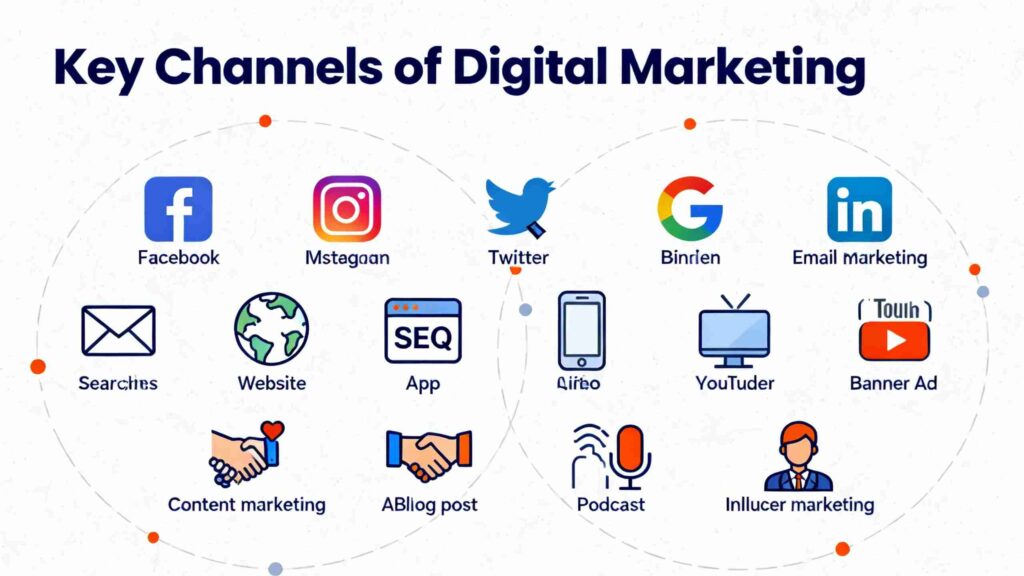
In today’s connected world, understanding the range of digital marketing channels available is crucial for businesses of all sizes. With more consumers spending time online across websites, social media, apps, and search engines, marketers must leverage the right channels to reach, engage, and convert audiences. As defined by Investopedia, digital marketing “utilizes websites, apps, mobile devices, social media, and search engines to promote products, establish brand awareness, and engage consumers.”
Similarly, as the team at Coursera explains, online marketing (another term for digital marketing) uses a variety of “digital channels and platforms to sell and promote brands, products, or services” while gathering data-driven insights.
In this blog post, we’ll explore the key digital marketing channels you should know, how they work, and how to decide which ones make sense for your business.
What Are Digital Marketing Channels?
Digital marketing channels are the online platforms, methods, and touch-points that businesses use to reach audiences, generate traffic, and ultimately drive action such as leads or sales. According to Semrush, digital marketing channels are “online platforms and methods businesses use to promote products, services, or brands.”
These channels enable targeting, measurement, and optimization in ways traditional marketing could not.
Why is it important to think about channels? Because:
Each channel has different strengths, audience behaviours, and cost models.
Successful digital marketing typically blends multiple channels rather than relying on one alone.
Choosing the right channels and using them effectively can boost your visibility, reputation, and results.
With that in mind, let’s dive into the major channels you should consider.
Major Digital Marketing Channels
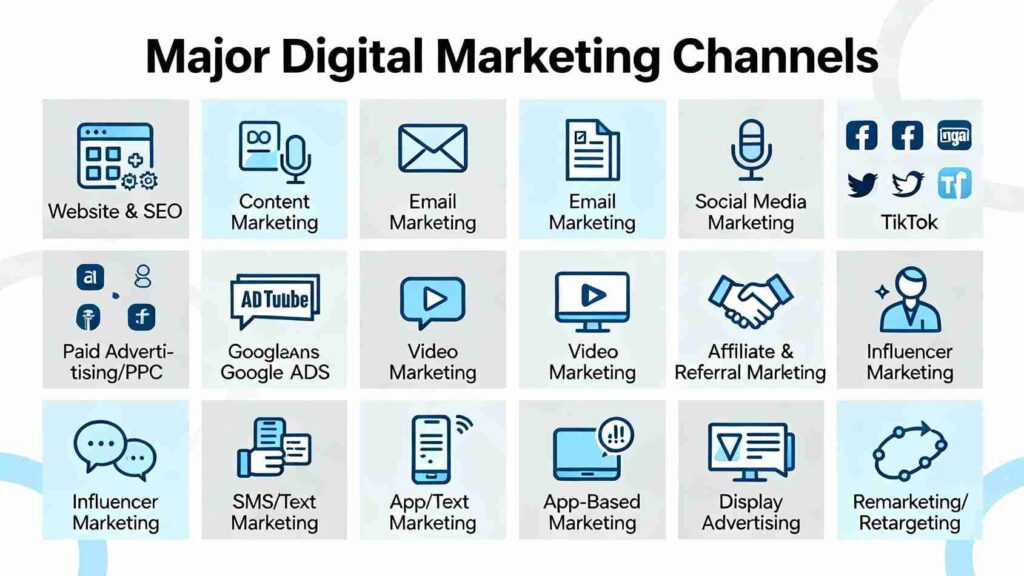
Here are the key digital marketing channels that many businesses use, along with brief descriptions of how they work and when to employ them.
1. Website Marketing Channel
A website remains the central hub of your digital presence, your owned platform where you control the message, brand, user experience, and conversions. According to Semrush, a website that “builds credibility and authority” increases reach and provides a platform to communicate with visitors.
When to use: Always. Your website is the foundation for nearly all other channels (SEO, content, paid ads, etc.). Without a strong website, some channels may underperform.
2. Search Engine Optimization (SEO)
SEO is about improving your website so it ranks higher in search engine results, bringing in unpaid (organic) traffic. As Semrush explains, SEO “generates unpaid traffic, leads, and sales” by targeting users who are actively searching.
Key tasks: Keyword research, on-page optimization (titles, meta, headings), technical SEO (site speed, mobile-friendly), backlink building.
When to use: Especially effective for long-term growth, also when you have content or services people are actively searching for.
3. Content Marketing
Content marketing involves creating and sharing valuable content such as blog posts, videos, infographics, and ebooks to attract and retain a defined audience. Semrush describes it as a channel that “guides them to take action (buy, subscribe, follow, etc.).”
Why it matters: It helps build trust, SEO rankings, social sharing, and brand authority.
When to use: If you want to educate your audience, build your brand over time, or drive inbound leads.
4. Social Media Marketing
Social media uses platforms like Facebook, Instagram, LinkedIn, TikTok, and others to engage audiences through content, interactions, ads, and brand storytelling. Semrush notes social media helps you “reach millions of daily active users … build trust and loyalty.”
When to use: If your audience spends time on social platforms and you want to build engagement, brand awareness, or direct response campaigns.
5. Email Marketing
Despite being one of the older “digital” channels, email remains very effective. According to Investopedia, email marketing is “still one of the most effective digital marketing channels.”
Use cases: Newsletters, promotions, nurturing leads, retention campaigns.
When to use: If you have a list of contacts (or are building one) and want to drive conversions from an already interested audience.
6. Paid Advertising / PPC
Paid advertising (often in the form of pay-per-click or display ads) lets you reach audiences quickly by paying for ad placement on search engines or social platforms. Semrush explains that you pay for specific audiences and measurable results.
Strengths: Fast results, tightly targeted, easily measurable.
Considerations: Requires budget and ongoing optimization.
When to use: When you want immediate visibility, have a clear offer, or want to support other channels (e.g., content promotion).
7. Video Marketing
Video is one of the most engaging formats in digital. Semrush highlights that video enables you to engage multiple senses and often communicates more effectively than text alone.
Platforms: YouTube, Instagram Reels, TikTok, Facebook Live, etc.
When to use: When your audience consumes video, when you can tell a story visually, or when you want to boost engagement and shareability.
8. Affiliate & Referral Marketing
These channels rely on partnerships: affiliates or referrers recommend your product/service to their audience and earn a commission or reward. According to Semrush, affiliate marketing gives access to established audiences and can provide cost-effective promotion.
Semrush
Referral marketing uses trust (word-of-mouth) and rewards for customers who refer others.
When to use: If you have a product suited for sharing (especially e-commerce), or if you can leverage influencers and partnerships.
9. Influencer Marketing
Influencer marketing involves collaborating with individuals who have strong followings to promote your brand. Semrush defines it as leveraging influencer credibility, existing communities, and backlinks.
When to use: If your audience listens to influencers, engages on social platforms, and you want to amplify your reach and authenticity.
10. SMS/Text & App-Based Marketing
Though less often featured as a key channel in every article, both Investopedia and Coursera mention SMS/text marketing and mobile-app channels. For example, Investopedia includes text messaging among digital marketing channels.
Coursera notes devices such as smartphone apps and SMS are part of today’s online marketing environment.
Use cases: Mobile apps, push notifications, SMS campaigns.
When to use: If you have a mobile-centric audience, app usage, or want to engage users on the go.
How to Choose the Right Channels for Your Business
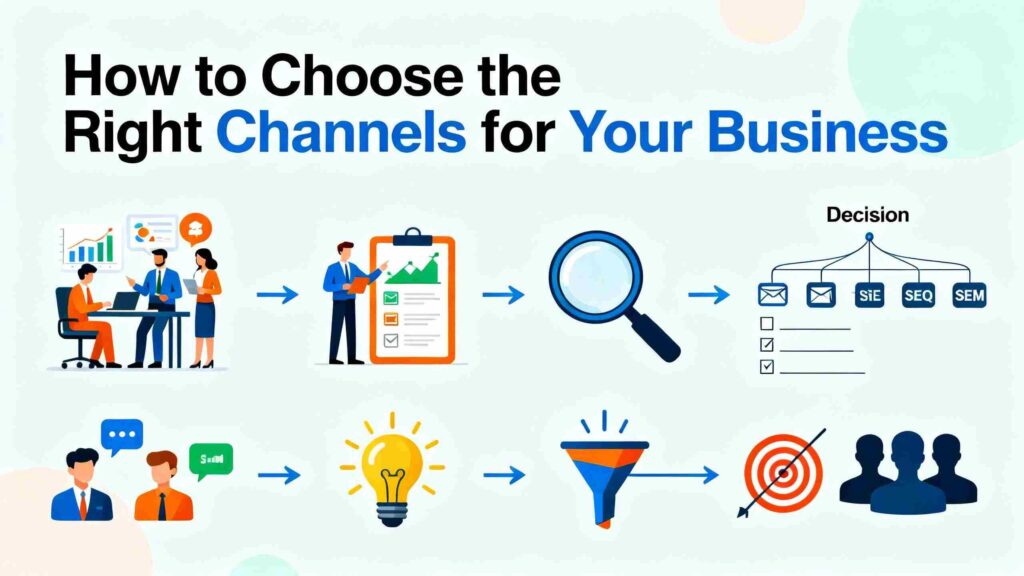
Having an inventory of digital marketing channels is one thing; choosing which to focus on is another. As Semrush advises, you don’t have to use every channel; instead, pick those aligned with your business type, audience, and budget.
Here’s a simplified framework:
Business Model & Goals
- Is your business B2B or B2C?
- Do you sell online, offline, or through a hybrid approach?
- What is your primary objective (brand awareness, lead generation, sales, retention)?
Audience & Behaviour
- Where does your target audience spend time online?
- What kinds of content or formats resonate (text, video, social, email)?
- What devices are they using (mobile, desktop, apps)?
- Budget & Resources
- Do you have a budget for paid channels, or are you focusing on organic growth?
- Do you have a team or skills for content creation (blogging, video, social)?
- Can you invest time in long-term channels (SEO, content) vs short-term channels (paid ads)?
Measurement & Optimization
- Do you have tracking setup (analytics, conversions)?
- Are you prepared to test, iterate, and scale what works?
- By aligning these factors, you can select 2-4 primary channels to start, gain traction, then expand if needed. Consistency and strategic focus often beat spreading yourself too thin.
Bringing It All Together: A Sample Channel Mix
- Here’s how you might combine channels into a coherent digital marketing strategy:
- Owned foundation: Website + blog (SEO + content marketing) → builds long-term organic traffic.
- Engagement & community: Social media (Instagram + LinkedIn) → build brand and interact with audience.
- Lead funnel: Email marketing → capture leads via content offers and nurture them.
- Conversion boost: Paid ads (Google Search + Facebook) → drive traffic to offers/landing pages.
- Amplification: Video content on YouTube + influencer partnerships → increase reach and social proof.
- Retention: SMS/app notifications + referral programs → engage and encourage repeat business.
- Over time, measure which channels are delivering the best results (traffic, leads, conversions, ROI), and reallocate budget and effort accordingly.
Conclusion
Understanding and leveraging the right digital marketing channels is key to modern marketing success. From your website and SEO to email, social, video, influencers, and beyond—each channel has its role and strengths. The most effective strategies identify the channels that align with their business, audience, and resources—and then optimize them for sustained results.
By prioritizing your channel mix, creating content and campaigns tailored to each channel’s audience and format, and consistently measuring performance, you’ll be well-positioned to grow your digital presence and marketing impact.
Ready to put this into practice? Choose your top 2-3 channels this quarter, define clear goals (e.g., increase website traffic by 20%, grow email list by 500 subscribers, launch 2 influencer collaborations), and track your progress weekly. Over time, expand into more channels as you gain confidence and resources.
For more resources about SEO, please visit https://www.lynderdigital.com/seo-resources/